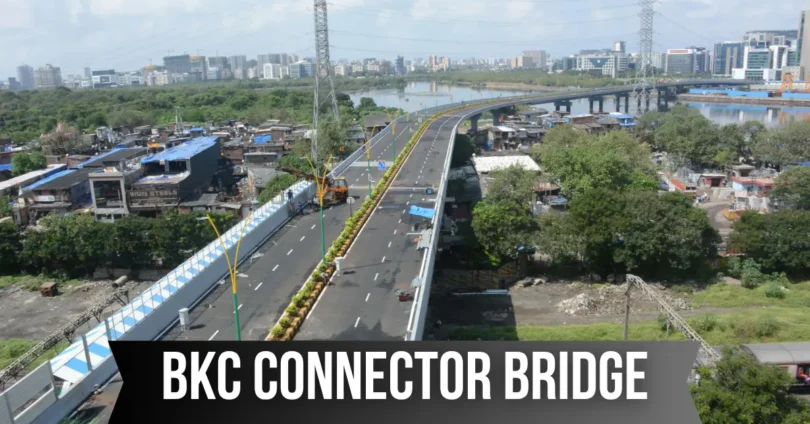
The BKC Connector Bridge is an elevated road structure in Mumbai built by MMRDA that connects the Eastern Express Highway to Bandra-Kurla Complex. It crosses the Mithi River, spans approximately 1.8 kilometres, and cuts peak-hour travel time from 50 minutes to under 15. The bridge is toll-free, open to all standard vehicles, and serves as the primary eastern access route into Mumbai’s busiest commercial district.
Mumbai’s roads are brutal. Anyone who has tried entering Bandra-Kurla Complex from the Kurla side during peak hours knows exactly how bad it gets. The BKC Connector Bridge was built to fix that and it does the job well.
This post covers everything about the BKC Connector Bridge what it is, where it is, how it was built, and why it matters for Mumbai’s daily commuters. Whether you use it every day or just want to understand Mumbai’s infrastructure better, you’ll find clear and useful information here.
What Is the BKC Connector Bridge?
The BKC Connector Bridge is an elevated road structure in Mumbai that connects the Eastern Express Highway to the Bandra-Kurla Complex. It was built to give commuters a fast, signal-free route into one of Mumbai’s most important commercial zones.
BKC houses the NSE, major banks, multinational offices, and the American Consulate. The volume of people and vehicles moving in and out of that area every day is enormous — and the existing roads simply couldn’t handle it.
Where Exactly Is It Located?
The bridge runs from the Eastern Express Highway near Kurla and connects directly into the BKC road network. It crosses over the Mithi River, which sits between the highway and BKC.
Commuters coming from Sion, Chembur, Ghatkopar, or further east on the highway now have a direct elevated entry into BKC without touching congested surface roads.
Why Was It Built?
BKC developed rapidly through the 2000s and 2010s. Office occupancy crossed high levels fast, and the road network around it couldn’t keep up.
The eastern side of BKC had no direct elevated connector to the Eastern Express Highway. Every vehicle coming from that direction had to fight through Kurla’s surface roads — signals, pedestrians, local traffic and all. The bridge closed that gap.
You may also like it:
Techabbey | Innovating the Future of Technology
Educationbeing com | How to Revolutionize Your Learning
Techloomz com | Your Ultimate Guide to Tech Solutions
Key Features of the BKC Connector Bridge
The BKC Connector Bridge is a multi-lane elevated structure built specifically for high-volume urban traffic. Its design accounts for Mumbai’s geography, monsoon conditions, and the commercial load of the BKC corridor.
Length and Design
The bridge stretches approximately 1.8 kilometres. It uses a prestressed concrete box girder design — the standard for urban flyovers in India because of its strength, durability, and ability to handle heavy loads over long spans.
The elevated design keeps it above the Mithi River floodplain, which is critical given Mumbai’s monsoon history and the flooding issues the city has faced in the past.
Lane Configuration
The bridge carries traffic in both directions with dedicated lanes on each side. This two-way flow prevents the bottlenecking that single-direction flyovers often create during peak hours.
During the 9 AM and 6 PM rush, having separated directional lanes makes a measurable difference to how smoothly traffic moves across the structure.
What Makes It Structurally Different
Three things separate this bridge from a standard Mumbai flyover:
- Mithi River crossing — required deeper foundations and flood-resistant engineering due to the river’s history of flooding during heavy monsoons
- Direct BKC grid integration — exit points feed into BKC’s main internal roads rather than dropping all traffic at one junction
- Heavy vehicle compatibility — built to handle commercial vehicles alongside private cars, which not all urban flyovers in Mumbai are rated for
How the BKC Connector Bridge Helps Mumbai’s Traffic
The bridge cuts travel time between the Eastern Express Highway and BKC significantly. A route that previously took 35 to 50 minutes during peak hours now takes roughly 10 to 15 minutes.
That improvement is consistent and measurable not just on paper but in daily commute experience.
Which Areas Does It Connect?
The bridge serves commuters coming from:
- Chembur, Ghatkopar, and Vikhroli — via the Eastern Express Highway
- Thane and Navi Mumbai — for anyone heading into BKC for work
- Sion and Kurla — the immediate feeder zones closest to the bridge entry
All of these areas previously had no direct elevated access into BKC from the east.
Travel Time Before and After
Before the bridge, peak-hour entry into BKC from the Eastern Express Highway involved multiple signals, merging traffic near Kurla station, and unpredictable delays.
The elevated corridor removes all of that. No signals, no merging with local traffic, no waiting at congested junctions. The time saving is real and consistent on most weekdays.
Effect on Surrounding Roads
The bridge pulls BKC-bound vehicles off surface roads and moves them through an elevated corridor. This reduces pressure on LBS Road, CST Road, and the Kurla junction network.
The Eastern Express Highway itself benefits too. Fewer vehicles exiting at Kurla’s busy junctions means slightly better flow for through-traffic heading toward Thane, Mulund, or JVLR.
Tip: Enter the bridge between 7:30 AM and 8:15 AM if you want the smoothest run. That window sits just before peak congestion builds at the BKC exit points.
Construction History and Timeline
The BKC Connector Bridge was planned and built by MMRDA — the Mumbai Metropolitan Region Development Authority — as part of a wider effort to improve road connectivity around BKC.
The project gained urgency as BKC grew into Mumbai’s primary financial district and existing roads became visibly inadequate.
When Was It Planned?
The eastern connectivity gap in BKC was identified in the early 2010s as office and commercial development in the area accelerated. MMRDA included the connector bridge in its road infrastructure plans for the BKC corridor during that period.
Who Built It?
MMRDA handled the planning and execution. Civil contractors with experience in Mumbai’s urban infrastructure carried out the construction — necessary given the complexity of building over the Mithi River within a dense, active urban zone.
Bridges crossing the Mithi River require additional clearances from BMC and state flood control authorities, which adds time and layers to the approval and construction process.
When Did It Open?
The bridge opened to public traffic and completed the eastern access route into BKC that commuters had needed for years.
For verified dates and contractor details, MMRDA’s official project records are the most reliable source. Their press releases from 2015 to 2020 cover the most active phases of this project’s development.
How to Use the BKC Connector Bridge
Using the BKC Connector Bridge is straightforward. There are no complex toll systems or restricted entry points — but knowing the right approach saves time, especially during peak hours.
Is It a Toll Bridge?
The BKC Connector Bridge does not have a separate toll plaza. It functions as part of Mumbai’s general urban road network under MMRDA’s jurisdiction, meaning regular commuters can use it without paying any additional charges at the bridge itself.
This makes it significantly more practical for daily office commuters compared to toll-based options like the Bandra-Worli Sea Link.
Which Vehicles Are Allowed?
The bridge is open to:
- Private cars and SUVs
- Taxis and app-based cabs (Ola, Uber)
- Light commercial vehicles
- Two-wheelers
- Auto-rickshaws
Heavy trucks and oversized vehicles may have restrictions during certain hours standard practice for urban elevated corridors in Mumbai.
Step-by-Step: How to Access the Bridge from the Eastern Express Highway
If you are approaching BKC from the Eastern Express Highway for the first time, follow this sequence:
- Stay on the Eastern Express Highway heading toward Mumbai from Thane or Sion
- Watch for the BKC Connector exit sign near Kurla it comes up before the main Kurla junction
- Take the ramp onto the elevated corridor
- Stay in the lane marked for BKC the bridge splits exit points depending on which part of BKC you need
- Use the G-Block or C-Block exit depending on your destination within BKC
- From the exit, you are directly inside BKC’s internal road grid within 2 to 3 minutes
Missing the entry ramp means dropping down to surface roads and dealing with Kurla’s junction traffic so watch the signage early.
Best Time to Use It
Peak congestion on the bridge builds between 8:30 AM and 10:30 AM in the morning and 6:00 PM to 8:30 PM in the evening.
Outside those windows particularly between 11 AM and 5 PM on weekdays the bridge moves freely with minimal slowdowns. Early morning users before 8 AM get the cleanest run in either direction.
You may also like it:
Tech ehla com | Your Guide to the Latest Tech Trends
Dailydishnews | Latest Updates & Top Stories
Newsreverse com | How to Get the Latest News and Updates
BKC Connector Bridge vs. Other Mumbai Flyovers
Mumbai has no shortage of flyovers and elevated roads. What makes the BKC Connector Bridge worth comparing is its specific purpose it was not built for general traffic distribution but for one precise corridor problem.
BKC Connector Bridge vs. Bandra-Worli Sea Link
These two structures serve completely different purposes but both impact BKC-area commutes.
| FactorBKC | Connector | BridgeBandra-Worli Sea Link |
| Purpose | Eastern highway to BKC | Western suburbs to South Mumbai |
| Toll | No separate toll | Yes, paid toll |
| Length | ~1.8 km | 5.6 km |
| Traffic type | Urban office commute | Cross-city long-distance |
| Peak benefit | Morning BKC entry | Evening south-bound exit |
The Sea Link solves a different problem it connects Bandra to Worli for people travelling toward South Mumbai. The BKC Connector solves the eastern access problem specifically.
If you work in BKC and live in Chembur or Thane, the BKC Connector Bridge is far more relevant to your daily commute than the Sea Link.
BKC Connector Bridge vs. JVLR Flyover
The Jogeshwari-Vikhroli Link Road flyover is another major elevated corridor that intersects with BKC-area traffic.
JVLR connects the western and eastern suburbs in a lateral direction essentially running perpendicular to the BKC Connector. They serve different axes of movement and complement each other rather than compete.
Commuters from Powai or Vikhroli often use JVLR to reach the Eastern Express Highway and then the BKC Connector for the final stretch into BKC making them part of the same practical route.
Where the BKC Connector Bridge Stands Out
Three things separate it from generic Mumbai flyovers:
- Precision of purpose — built for one specific connectivity gap, not general traffic relief
- No toll barrier — removes friction for daily commuters who use it twice a day
- Direct BKC grid integration — exits drop you inside BKC, not at its edge
Most Mumbai flyovers move traffic from one congested point to another slightly less congested point. This one moves traffic from the highway directly into a functional commercial zone which is a meaningful design difference.
Frequently Asked Questions About the BKC Connector Bridge
What is the BKC Connector Bridge?
The BKC Connector Bridge is an elevated road in Mumbai that links the Eastern Express Highway to Bandra-Kurla Complex. It gives commuters from Kurla, Chembur, and Thane a direct, signal-free route into BKC without using congested surface roads. MMRDA built and manages it.
Is the BKC Connector Bridge a toll road?
No, the BKC Connector Bridge does not charge a separate toll. Commuters can use it freely as part of Mumbai’s regular road network. This makes it one of the more practical daily-use bridges in the city, especially for office workers entering BKC twice every day.
How long is the BKC Connector Bridge?
The bridge is approximately 1.8 kilometres long. It runs from the Eastern Express Highway near Kurla, crosses over the Mithi River, and connects directly into BKC’s internal road grid. The elevated length is enough to bypass all surface-level signals and junction traffic completely.
Which areas does the BKC Connector Bridge connect?
It connects the Eastern Express Highway to Bandra-Kurla Complex. Commuters from Chembur, Ghatkopar, Vikhroli, Thane, and Navi Mumbai benefit most. Anyone travelling toward BKC from the eastern or central suburbs of Mumbai can use this bridge as their primary entry route.
How much time does the BKC Connector Bridge save?
It cuts peak-hour travel time from roughly 35 to 50 minutes down to around 10 to 15 minutes. The saving comes from bypassing Kurla’s surface roads, signals, and junction traffic entirely. For daily commuters, that adds up to a significant amount of time saved every week.
What vehicles can use the BKC Connector Bridge?
Private cars, taxis, two-wheelers, auto-rickshaws, and light commercial vehicles can all use the bridge. Heavy trucks and oversized vehicles may face restrictions during certain hours. App-based cabs like Ola and Uber use it regularly, making it a common route for cab rides into BKC.
Who built the BKC Connector Bridge?
MMRDA — the Mumbai Metropolitan Region Development Authority — planned and executed the BKC Connector Bridge. They used experienced civil contractors familiar with Mumbai’s urban construction challenges, including the added complexity of building a river-crossing structure over the flood-prone Mithi River.
What is the best time to use the BKC Connector Bridge?
The smoothest window is before 8:15 AM or between 11 AM and 5 PM on weekdays. Peak congestion builds from 8:30 AM to 10:30 AM and again from 6 PM to 8:30 PM. Early morning users get the cleanest, fastest run across the bridge in either direction.
Does the BKC Connector Bridge cross the Mithi River?
Yes, the bridge crosses over the Mithi River, which sits between the Eastern Express Highway and BKC. This required deeper foundations and flood-resistant engineering. After Mumbai’s 2005 floods, any structure built over the Mithi River undergoes much stricter engineering and approval requirements before construction begins.
How does the BKC Connector Bridge help reduce Mumbai traffic?
It works as a pressure valve for the entire eastern BKC corridor. By pulling thousands of vehicles off surface roads and moving them through an elevated route, it reduces congestion on LBS Road, CST Road, and Kurla’s junction network — benefiting even drivers who never use the bridge directly.
Conclusion
So, in this article, we covered the BKC Connector Bridge in detail — its design, construction, traffic impact, and how to use it effectively as a daily commuter.
The bridge is one of Mumbai’s quieter infrastructure wins. No toll, direct BKC access, and a consistent time saving that surface roads simply cannot match during peak hours.
For daily eastern suburb commuters, this bridge should already be a permanent part of your route.
If you found this useful, check out our article on the Bandra-Worli Sea Link — another major Mumbai bridge that shapes how the city moves.
You may also like it:
Autolinkrush com | Your Ultimate Guide to Car Solutions
Greenfield Stadium Pitch Report – Batting or Bowling?