
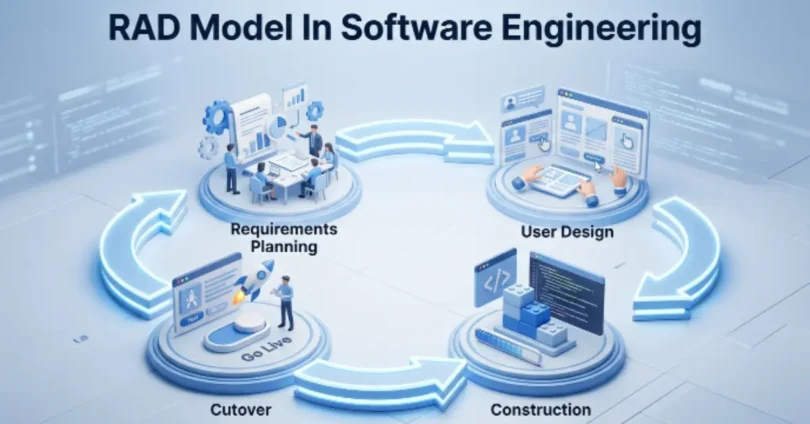
Software development projects often need to be completed quickly without reducing quality. This is where the RAD Model In Software Engineering becomes useful. RAD stands for Rapid Application Development. It focuses on fast development, regular user feedback, and quick delivery of working software.
The RAD Model In Software Engineering helps development teams build applications in less time by using prototypes and continuous improvements. Many businesses choose this model when they need software solutions quickly and want users to be involved throughout the development process. In this article, you will learn how the RAD model works, its phases, advantages, disadvantages, and when it is the right choice for a project.
What Is RAD Model In Software Engineering?
The RAD Model In Software Engineering is a software development approach that focuses on building applications quickly through continuous user feedback and rapid prototyping. Instead of spending a long time on planning, developers create working models early and improve them based on user suggestions.
The main goal of the RAD model is to deliver high-quality software faster while keeping users involved throughout the development process.
Simple Definition of RAD Model In Software Engineering
The RAD model helps developers create software in a shorter time by using quick prototypes, frequent testing, and regular user feedback.
Key Points
- RAD stands for Rapid Application Development.
- It focuses on speed and flexibility.
- Users actively participate during development.
- Developers improve the software through multiple versions.
Key Characteristics of RAD Model In Software Engineering
The RAD model has several features that make it different from traditional software development methods.
Rapid Development
The model focuses on completing projects quickly.
- Development tasks are divided into smaller parts.
- Teams work on different modules at the same time.
- Working software is delivered faster.
- Changes can be made without major delays.
Continuous User Feedback
Users play an important role throughout the project.
- Users review prototypes regularly.
- Feedback helps improve the software.
- Problems are identified early.
- Final products match user expectations better.
Prototype-Based Approach
Developers create sample versions before the final product.
- Prototypes show how the software will work.
- Users can test features early.
- Design issues are found quickly.
- Development becomes more accurate.
Flexible Development Process
The model allows easy modifications during development.
- New features can be added when needed.
- Changes do not require starting over.
- Teams can respond to business needs quickly.
- Project flexibility improves overall results.
When To Use RAD Model In Software Engineering
The RAD model works best in specific situations where speed and user involvement are important.
For Projects With Tight Deadlines
When software must be delivered quickly, RAD can be a good choice.
- Development cycles are shorter.
- Teams can release products faster.
- Businesses can meet market demands quickly.
When Requirements Are Clear
The model performs well when project goals are already known.
- Developers understand user needs from the start.
- Prototypes can be created quickly.
- Development becomes more efficient.
When User Feedback Is Available
RAD depends heavily on user participation.
- Users can review progress regularly.
- Teams can make improvements based on suggestions.
- Final software becomes more user-friendly.
For Small And Medium-Sized Projects
RAD is often suitable for projects with manageable complexity.
- Development remains organized.
- Teams can work efficiently.
- Project costs and timelines stay under control.
Example: A company that needs a customer management system within a few months can use the RAD model. Developers create a prototype, gather employee feedback, make improvements, and deliver the final software much faster than traditional methods.
You may also like it:
Techabbey | Innovating the Future of Technology
Educationbeing com | How to Revolutionize Your Learning
Techloomz com | Your Ultimate Guide to Tech Solutions
Phases of RAD Model in Software Engineering
The RAD Model In Software Engineering works in clear phases that help teams build software quickly and efficiently. Each phase focuses on speed, user feedback, and iterative improvement.
Requirement Planning
This phase gathers all the necessary requirements quickly.
- Developers and users meet to discuss project goals.
- Only essential requirements are prioritized to save time.
- Teams identify potential risks and challenges early.
- Quick planning helps start development without delays.
User Design
Prototypes are created, and users provide feedback.
- Developers make simple models to show how the software will work.
- Users test the prototypes and suggest improvements.
- Designs are updated continuously based on feedback.
- Ensures the software meets user expectations from the start.
Construction
The actual software is built rapidly using modules and prototypes.
- Developers work on small parts simultaneously.
- Prototypes are turned into fully functional modules.
- Frequent testing ensures each module works correctly.
- Changes can be made quickly without delaying the project.
Cutover / Implementation
The final phase involves testing, deployment, and user training.
- Complete software is tested for errors and performance issues.
- Users are trained to use the system effectively.
- Any final adjustments are made before full deployment.
- Software goes live and starts serving its intended purpose.
Example: Imagine a company needs a new inventory system fast. In the requirement phase, they decide on key features. In user design, employees try prototypes and suggest improvements. During construction, developers build modules quickly. Finally, in cutover, the system is tested, deployed, and employees are trained to use it efficiently.
Advantages of RAD Model In Software Engineering
The RAD Model In Software Engineering offers several benefits that help teams develop software faster and more efficiently. It focuses on quick development, regular feedback, and continuous improvements.
Faster Development
The RAD model helps teams complete projects in less time.
- Development starts quickly with minimal planning.
- Teams work on multiple modules at the same time.
- Prototypes speed up the development process.
- Software can be delivered much faster than traditional models.
Better User Involvement
Users stay involved throughout the software development process.
- Users provide feedback at every stage.
- Developers understand user needs more clearly.
- Changes can be made based on real user suggestions.
- The final product becomes more user-friendly.
Reduced Risk Of Project Failure
Regular testing and feedback help identify problems early.
- Issues are detected before they become major problems.
- Continuous improvements increase software quality.
- User expectations are addressed throughout the project.
- The chances of developing unwanted features are reduced.
Improved Flexibility
The RAD model allows changes during development.
- New requirements can be added easily.
- Teams can respond quickly to business needs.
- Modifications do not require rebuilding the entire project.
- Development remains adaptable and efficient.
Example Of A Real-Life Project Using RAD
Many businesses use the RAD model when they need software quickly.
- A retail company may need an inventory management system within a short deadline.
- Developers first create a working prototype for employees.
- Employees test the system and share feedback.
- Developers improve the software and deliver the final version quickly.
Example: A hospital needs an appointment booking system. Using the RAD model, developers build a prototype, doctors and staff test it, feedback is collected, and improvements are made. This process helps deliver a reliable system in a shorter time while meeting user requirements.
You may also like it:
Tech ehla com | Your Guide to the Latest Tech Trends
Dailydishnews | Latest Updates & Top Stories
Newsreverse com | How to Get the Latest News and Updates
Disadvantages of RAD Model In Software Engineering
While the RAD Model In Software Engineering is fast and flexible, it also has some limitations that teams need to consider before using it.
High Dependency On Skilled Developers
The RAD model requires experienced and skilled developers to work efficiently.
- Teams must know how to create prototypes quickly.
- Skilled developers are needed to handle rapid changes.
- Inexperienced teams may struggle with the fast pace.
- Poorly managed development can lead to mistakes.
Not Suitable For Large, Complex Projects
RAD works best for small to medium-sized projects, not very large ones.
- Managing many modules at once can become complicated.
- Large projects require extensive planning and coordination.
- Continuous changes may cause confusion in bigger teams.
- RAD may not meet the needs of highly complex systems.
Cost Considerations
Using RAD can be more expensive in some cases.
- Hiring skilled developers can increase costs.
- Multiple prototypes may require extra resources.
- Rapid changes can add to development expenses.
- Small teams may struggle with budget management.
Example: A small startup can use RAD to build a mobile app quickly. But for a large banking system with many modules, RAD may not work efficiently and can become costly.
When To Use RAD Model In Software Engineering
The RAD Model In Software Engineering works best in certain situations where speed, user involvement, and flexibility are key. Knowing when to use it helps ensure project success.
Ideal Project Types
RAD is suitable for projects that can benefit from rapid development and iterative feedback.
- Small to Medium Projects: Works best when project complexity is manageable.
- Projects With Clear Requirements: When user needs are mostly known in advance.
- Projects Needing Quick Delivery: Useful when deadlines are tight.
- Software Requiring Frequent User Feedback: Ideal for applications that need regular updates and improvements.
Team And Resource Requirements
Successful RAD implementation depends on having the right team and resources.
- Skilled Developers: Team members must be capable of rapid prototyping and fast coding.
- Active User Participation: Users should be available to give feedback frequently.
- Strong Communication: Developers and users must communicate clearly to avoid errors.
- Adequate Tools and Technology: Access to development tools that support fast prototyping is essential.
Example: A company wants a customer support system ready in a few months. With a skilled development team, active employee feedback, and proper software tools, RAD allows the system to be built and improved quickly, meeting user needs efficiently.
RAD Model vs Other Software Development Models
The RAD Model In Software Engineering is different from traditional models like Waterfall, Agile, and Spiral. Understanding the differences helps you choose the right approach for your project.
Comparison With Waterfall Model
Waterfall is a linear, step-by-step development model.
- RAD is fast and iterative, while Waterfall is slow and sequential.
- RAD allows frequent changes; Waterfall requires complete planning upfront.
- RAD involves users continuously; Waterfall involves users mostly at the start and end.
- Waterfall is better for projects with fixed requirements.
Quick Pros and Cons:
- RAD Pros: Fast delivery, user involvement, flexible.
- RAD Cons: Needs skilled developers, not ideal for large projects.
- Waterfall Pros: Clear structure, easy to manage for simple projects.
- Waterfall Cons: Slow, hard to accommodate changes.
Comparison With Agile Model
Agile is iterative and flexible, similar to RAD in some ways.
- Both RAD and Agile allow frequent updates and user feedback.
- RAD focuses on rapid prototypes, while Agile focuses on working software in short sprints.
- Agile is better for complex projects with evolving requirements.
- RAD is faster for small to medium projects.
Quick Pros and Cons:
RAD Pros: Very fast, prototype-driven.
RAD Cons: Limited for very large projects.
Agile Pros: Flexible, scalable, supports continuous improvement.
Agile Cons: Requires strict planning and disciplined teams.
Comparison With Spiral Model
Spiral combines iterative development with risk analysis.
- RAD emphasizes speed; Spiral emphasizes risk management.
- Spiral works well for large, complex, and high-risk projects.
- RAD is simpler and faster but less focused on risk analysis.
- Spiral uses multiple iterations like RAD but with more documentation.
Quick Pros and Cons:
- RAD Pros: Fast, user-focused, simple to implement.
- RAD Cons: Limited risk handling, not for huge projects.
- Spiral Pros: Reduces risk, supports large projects, iterative.
- Spiral Cons: Complex, time-consuming, needs experienced team.
Example: For a small retail app, RAD is ideal because it delivers quickly with user feedback. For a banking system with complex security requirements, Spiral or Agile may be a better fit.
Conclusion
The RAD Model In Software Engineering is a fast and flexible software development approach that focuses on quick delivery and continuous user feedback. It helps teams build high-quality software in less time while keeping users involved throughout the process.
Although it may not be suitable for large and highly complex projects, it works very well for small to medium-sized applications with clear requirements. By understanding its phases, advantages, and limitations, businesses can decide whether the RAD model is the right choice for their software development needs.
FAQs About RAD Model In Software Engineering
Q. What is RAD Model in Software Engineering?
A. RAD stands for Rapid Application Development. It is a fast software development method that uses prototypes and regular user feedback to deliver applications quickly.
Q. What are the advantages of RAD Model in Software Engineering?
A. Key benefits include faster development, better user involvement, reduced risk of project failure, and flexibility to make changes quickly.
Q. What are the disadvantages of RAD Model in Software Engineering?
A. RAD depends on skilled developers, is not ideal for very large or complex projects, and can be more costly due to prototypes and rapid changes.
Q. When should I use RAD Model in Software Engineering?
A. It works best for small to medium-sized projects with clear requirements, tight deadlines, and active user participation.
Q. How is RAD different from Waterfall, Agile, or Spiral models?
A. RAD focuses on speed and prototypes, Waterfall is sequential, Agile uses short iterative sprints, and Spiral emphasizes risk analysis. RAD is fastest for small projects with active user feedback.
Q. Can RAD Model handle large projects?
A. Usually not. It works better for small to medium projects because large projects are harder to manage with rapid prototypes and continuous changes.
Q. Is RAD suitable for beginners?
A. Yes, if they have guidance and skilled team support. However, inexperienced teams may struggle with the fast pace and iterative changes.
You may also like it:
Autolinkrush com | Your Ultimate Guide to Car Solutions
Greenfield Stadium Pitch Report – Batting or Bowling?